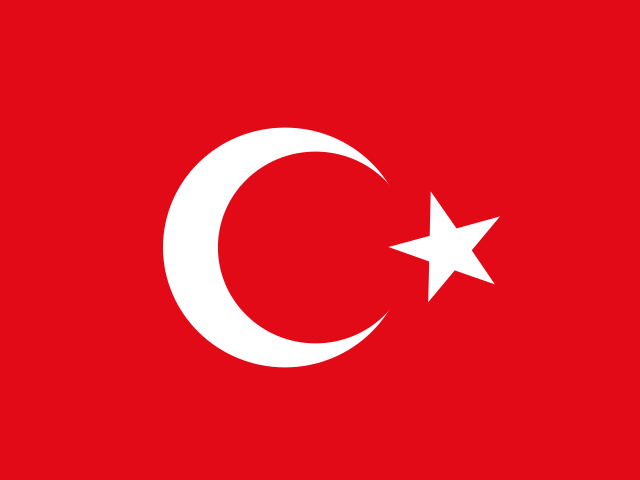
Türkiye straddles both Europe and Asia, with the majority of its land lying on the Anatolian Peninsula in western Asia. It is known for its rich history as the heart of several great empires, including the Ottoman Empire, as well as its stunning landscapes ranging from coastal beaches to volcanic plateaus. The country is a cultural crossroads where East meets West, reflected in its cuisine, architecture, and traditions.
- Capital
- Ankara
- Continent
- Asia
- Region
- Western Asia
- Area
- 783,562 km²
- Coordinates
- 39° N, 35° E
- Languages
- Turkish
- Currency
- TRY ₺
- Domain
- .tr
- Calling code
- +90
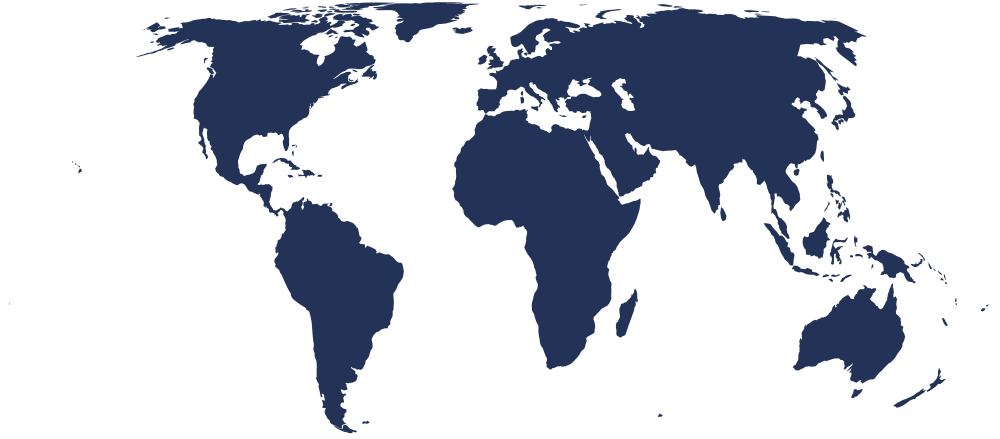
On the world map
Bordering countries
 Armenia
 Azerbaijan
 Bulgaria
 Georgia
 Greece
 Iran
Iran Iraq
Iraq Syria
SyriaCountry facts
- Istanbul, Türkiye's largest city, is the only major city in the world that spans two continents, Europe and Asia.
- The Turkish language belongs to the Turkic language family and uses a Latin-based alphabet introduced by Mustafa Kemal Atatürk in 1928.
- Türkiye is home to the ancient site of Troy, the legendary city from Homer's Iliad, located in the northwest of the country.
- The tulip, often associated with the Netherlands, actually originated in Central Asia and was cultivated and popularized by the Ottomans before spreading to Europe.
- Cappadocia, in central Türkiye, features dramatic 'fairy chimney' rock formations carved by volcanic eruptions millions of years ago.
Capital facts
- Ankara has served as the capital of Türkiye since 1923, when Mustafa Kemal Atatürk established it as the seat of the new republic.
- Before becoming the capital, Ankara was a modest trading town historically known for the soft wool of its Angora goats.
- The Anıtkabir, a grand mausoleum completed in 1953, stands in Ankara and is the resting place of Mustafa Kemal Atatürk.
- Ankara is home to the Museum of Anatolian Civilizations, which houses one of the world's finest collections of ancient Anatolian artifacts.
- The city sits on a high central plateau at an elevation of about 850 meters, giving it a colder and drier climate than coastal Turkish cities.