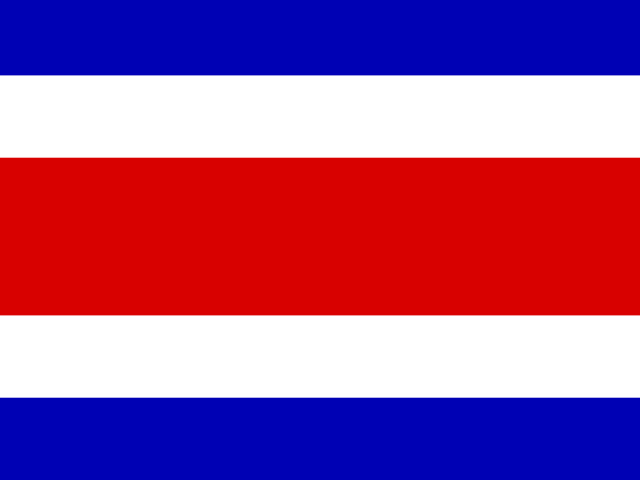
Costa Rica is a small Central American country bordered by Nicaragua to the north and Panama to the south, with coastlines on both the Pacific Ocean and the Caribbean Sea. It is celebrated for its remarkable biodiversity, with lush rainforests, active volcanoes, and a wide variety of wildlife. The country is also internationally recognized for abolishing its military in 1948 and prioritizing environmental conservation.
- Capital
- San José
- Continent
- Americas
- Region
- Central America
- Area
- 51,100 km²
- Coordinates
- 10° N, 84° W
- Languages
- Spanish
- Currency
- CRC ₡
- Domain
- .cr
- Calling code
- +506
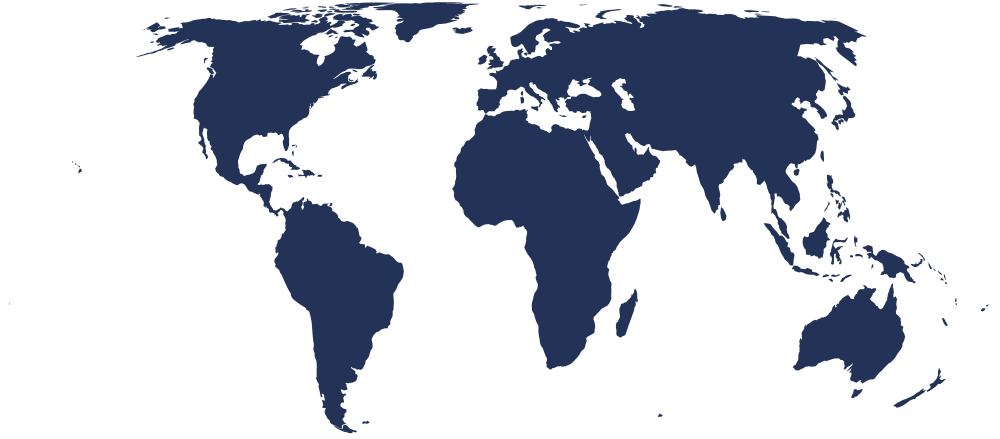
On the world map
Bordering countries
 Nicaragua
 Panama
Country facts
- Costa Rica abolished its armed forces in 1948, becoming one of the few countries in the world without a standing military.
- Despite covering less than 0.03% of Earth's surface, Costa Rica is home to around 5% of the world's known biodiversity.
- Spanish is the official language, and Costa Ricans often call themselves 'Ticos' as a friendly nickname.
- The country generates the vast majority of its electricity from renewable sources, including hydropower, geothermal, and wind energy.
- The resplendent quetzal, a brilliantly colored bird sacred to pre-Columbian Mesoamerican cultures, can be found in Costa Rica's cloud forests.
Capital facts
- San José was founded in 1736 and became the capital of Costa Rica in 1823, replacing Cartago.
- The city sits on a broad highland plateau in the Central Valley at an elevation of about 1,170 meters above sea level, giving it a mild climate year-round.
- The National Theater of Costa Rica, inaugurated in 1897, is considered one of the most beautiful buildings in Central America.
- San José is home to the Gold Museum, which houses an impressive collection of pre-Columbian gold artifacts made by indigenous peoples.
- The city serves as the political, economic, and cultural hub of Costa Rica, hosting the country's main universities, government institutions, and international businesses.