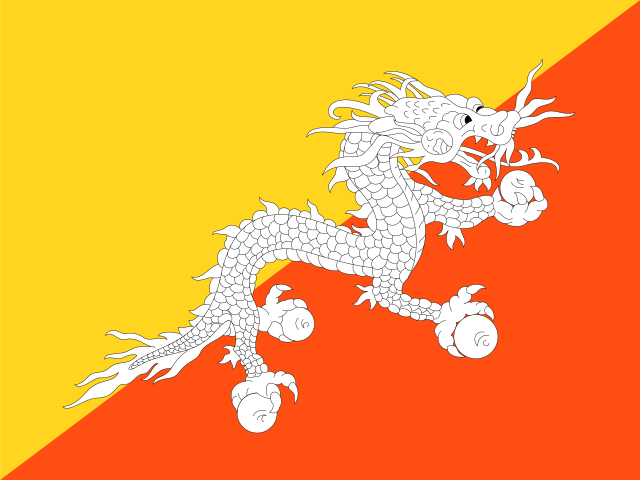
Bhutan is a small, landlocked kingdom nestled in the eastern Himalayas, bordered by India and China. It is renowned for its policy of measuring national progress through Gross National Happiness rather than GDP. Dense forests, dramatic mountain valleys, and ancient Buddhist monasteries define much of the country's landscape and culture.
- Capital
- Thimphu
- Continent
- Asia
- Region
- Southern Asia
- Area
- 38,394 km²
- Coordinates
- 28° N, 91° E
- Languages
- Dzongkha
- Currency
- BTN Nu., INR ₹
- Domain
- .bt
- Calling code
- +975
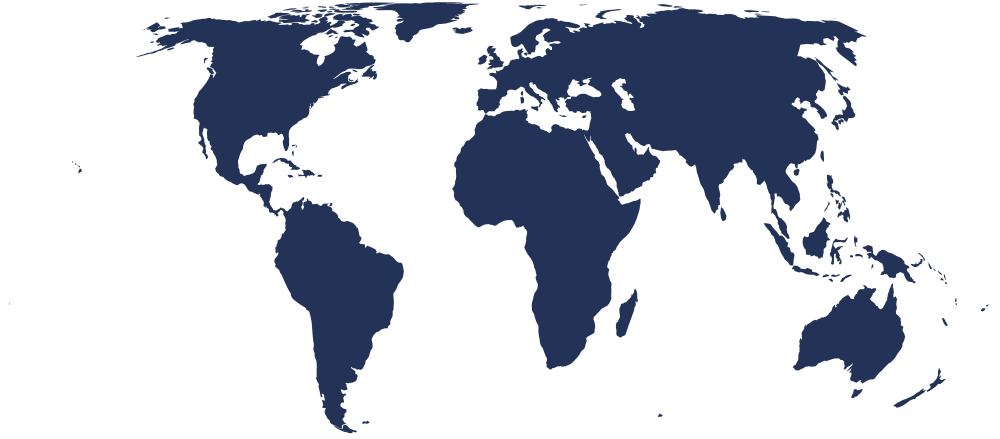
On the world map
Bordering countries
 China
China India
IndiaCountry facts
- Bhutan is the only country in the world that officially measures national well-being through Gross National Happiness.
- The country was never formally colonized by a European power, preserving much of its traditional culture and governance.
- Bhutan only opened its borders to foreign tourists in 1974, and it still limits visitor numbers to protect its culture and environment.
- The national language is Dzongkha, which is written in the Tibetan script known as Uchen.
- Bhutan is one of the world's few carbon-negative countries, absorbing more carbon dioxide than it produces thanks to its vast forests.
Capital facts
- Thimphu became Bhutan's official capital in 1961, replacing the historic town of Punakha which had previously served that role.
- The city is home to the Tashichho Dzong, a large fortress-monastery that houses the throne room and offices of the king.
- Thimphu is one of the few capitals in the world without a single traffic light, with traffic historically managed by white-gloved police officers at key intersections.
- The Memorial Chorten, a large Buddhist stupa built in 1974 to honor the third king, is one of the most visited landmarks in the city.
- Situated at an elevation of about 2,300 metres above sea level, Thimphu is among the highest capital cities in Asia.